

Demand Creation Sales 101: PACERS
The framework for winning deals that don't yet exist

The best closer you’ve ever met might be the worst hire you’ve ever made.
The interview went perfectly. Six rounds. Everyone loved him.
He had seven years at Microsoft followed by growth roles at Salesforce and Oracle hitting above quota, quarter after quarter. His references called him “a killer.”
You made the offer. He gleefully accepted.
One year later: he’s in your office arguing the only way to win is to cut the price. You’re looking at a pipeline full of made-up numbers and notes on prospects who took one meeting but never a second. There is a laundry list of forecasted deals that slipped from Q1 to Q2 to Q3 to “next year” mocking you out of the corner of your eye.
You ask him, “what do you think is going on?”
He tells you he’s running Miller Heiman while he pulls up a Blue Sheet on his laptop. He suggests product or price has to be the problem.
This story isn’t unique, I see it happen time and time again. If you’re a founder who’s watched a great resume fail, a first sales hire figuring it out alone, a head of GTM who can close but can’t build a repeatable system, or a VC watching your portfolio companies struggle to grow revenue, keep reading.
The Real Problem
The problem starts with language. We use one word, “sales,” to describe two different jobs. Demand response and demand creation. (I wrote about this distinction here). These two disciplines require different skills, different mindsets and different drive.
Solving this takes more than one thing: better strategic reputation, better comp plans, better training. But none of that works without a framework underneath it. The right framework gives you something to build systems on, something to test talent against, and something to teach so you’re not hunting for the needle in a haystack hire. And, it has to be simple enough that a founder with no sales background can actually use it.
The Framework Gap
MEDDIC won’t help. Neither will Sandler, SPIN, or Challenger. They’re good concepts or frameworks, but they assume demand already exists. They teach you to qualify a pipeline and close deals, but they don’t teach you how to make someone care about a problem they didn’t know they had.
So where do you learn what actually works? There’s no undergraduate degree in sales and surprisingly no MBA concentration either. Why business schools skip the most critical part of building a company is lost on me. The one methodology I’ve seen work for demand creation is Revenue Storm. I’ve deployed it for ten years, but it’s the PhD. It’s for someone like me, a CRO who has specialized in demand creation as a career. A founder trying to prove a vision doesn’t have time for a PhD in sales. And after training dozens of demand response salespeople on it, I’ve watched most of them nod along and fail to execute. They say they get it but, it’s obvious they don’t.
PACERS
We need the undergrad before the PhD. And since I couldn’t find one, I decided to build one.
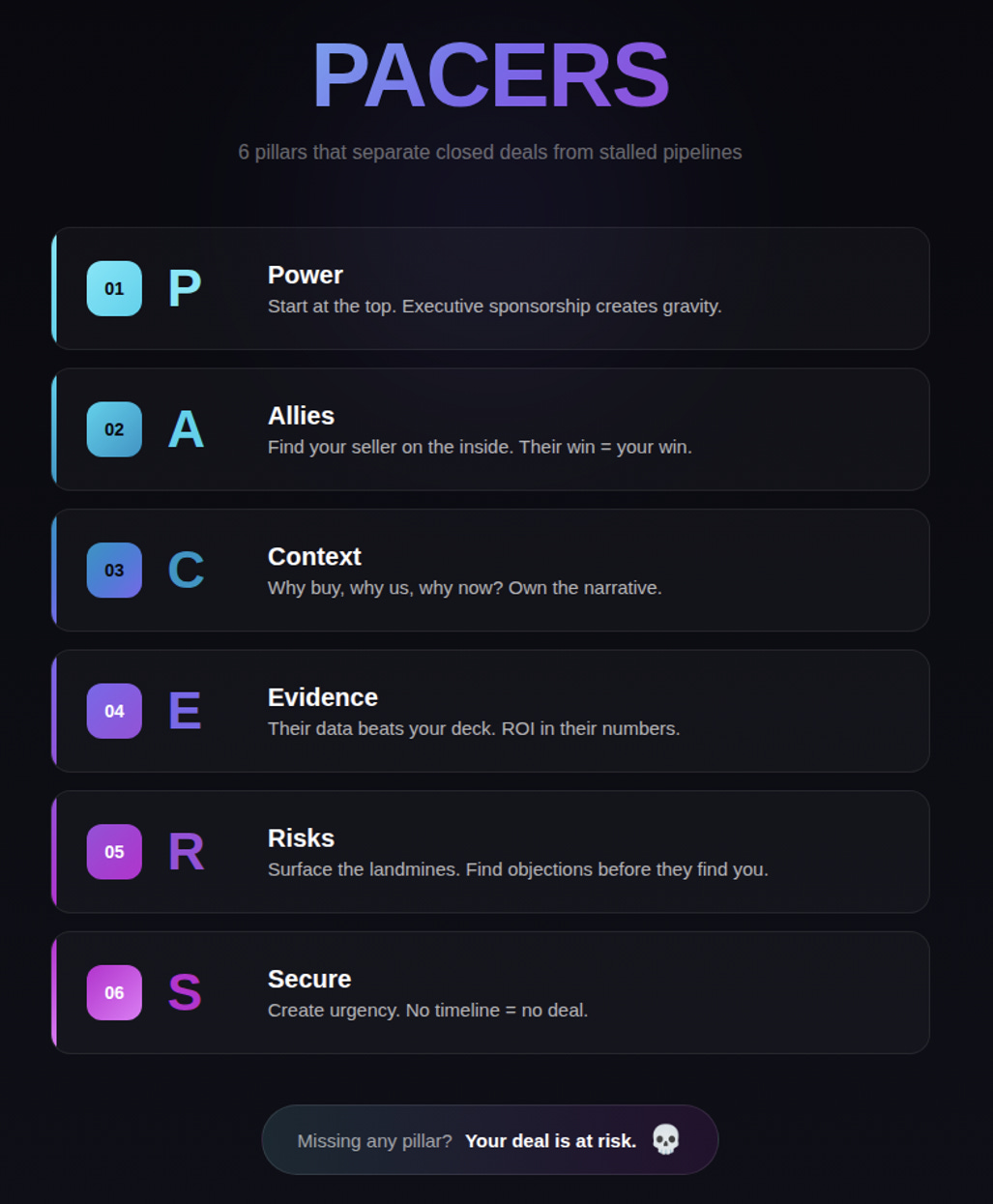
After watching this pattern repeat for years, I stopped asking “why do good salespeople fail?” I went back and studied the deals that actually worked: the ones that closed when the market was against us, the ones where we beat the incumbent everyone assumed would win, and the ones where we created budgets that didn’t exist before we showed up. Six things kept showing up:
Power. Open the account at the top.
Mandates, money, and momentum live there. If a C-suite executive sees a win in your story, they’ll open doors you’d never get through otherwise. The lower you start, the more you inherit: by-the-book thinkers, people who need permission and people who can say no but never yes.
Allies. Don’t sell alone.
An ally is someone whose personal win is attached to your success. Don’t confuse a contact or supporter for an ally. The person who returns your calls is a contact. The person who likes your solution but won’t fight for you is a supporter. But an ally has skin in the game.
Context. Create the emotional buy.
Whoever defines the problem controls the timeline. Why buy anything at all? Why buy now? Why buy from us? Who else could provide this outcome? The answers shift depending on who you’re talking to. The CEO wants growth. Your VP ally wants to look smart for finding you. Same solution, two different emotional buys and personal wins, connected by a business goal. Define each one and validate them.
Evidence. Give them the logic to justify their emotional buy.
The best evidence is their own data. Case studies say “it worked somewhere.” Their data says “it works here.”
Risk. Deals die from concerns you didn’t squash.
Know the risks and address them before a detractor raises them. Don’t forget that sometimes your biggest competitor is “do nothing.”
Secure. You need a forcing function.
Without an agreed closing date, demand creation deals slip because you’re filling white space they didn’t know they needed. The best forcing function comes from existing deadlines: budget cycles, board meetings. Tie your deal to something they already promised. If delay means they miss a commitment, the deal closes. If delay is just inconvenient, it may shift.
Power. Allies. Context. Evidence. Risk. Secure. PACERS. The undergraduate course that should come before the PhD.
Each step builds on the one before it. Skip one and the deal stalls. Get the sequence wrong and you delay or lose your deal.
That’s the framework in theory, here’s how it works in practice.
Turning a $30M Opportunity into a $50M Close
Earlier in my career, I joined a large company after spending time at a startup where I was drilled in demand creation sales. I’m one of the lucky few who got the undergraduate and PhD in demand creation very early in my career. I’ve anonymized some details here on purpose. I want to protect my former companies and teammates. But the strategy I detail is exactly what happened.
Six months into that role, we got pulled into an RFP from a Fortune 200 in crisis. The opportunity was huge, a $30M deal, but the likelihood of us winning was incredibly uncertain.
We were competing against multiple vendors. We had a history of good, reliable business with this customer, but they were looking for something new. We were pushing a product that had the potential to increase our company’s growth across all customers by 30%, but it hadn’t yet been adopted or proven anywhere. All happening at a time when the world had shifted to remote work with no clarity on how selling without being in person would unfold.
Most sales leaders would have played it safe and stuck to the RFP requirements while competing on price and features.
We didn’t. We used demand creation to turn a 50/50 shot into an 90/10 potential.
Power. Initially, we were mapped at the manager level. Well, so was every competitor. I heard it a dozen times: if you go around them, you’re toast. So I didn’t. My boss’s boss did. Our SVP secured a meeting with their CEO.
Could we have won staying at the manager level? Maybe. But we’d be one of five to ten vendors answering the same RFP with a similar pitch. That CEO meeting changed everything. We learned what mattered at the top: improving customer sentiment after a crisis. Realistically, no manager or procurment lead was ever going to tell us that.
The executive who joined the CEO call saw we were playing at a different level and saw a path to her own benefit. She became our ally.
Allies. The executive from the CEO meeting had a problem nobody was talking about in the RFP. The company’s brand was damaged, public trust was shaky and economic pressure was making customers more cost-conscious than ever. Customer sentiment was mostly negative and it was this executive’s entire mandate to deliver a strategy that helped fix that relationship. Our product was a way for their customers to lower costs, engage positively, and feel empowered during this time of uncertainty. We found their personal win.
Context. We didn’t pitch features to the CEO or our ally. We didn’t mention features until we wrote our RFP submission. Gasp, I know. This is uncomfortable for product-focused founders.
Instead, we reframed the conversation around brand recovery and customer empowerment. We published thought leadership on how companies in their industry could turn crisis into opportunity. By the time we were shortlisted, the leadership team was already thinking in our framework.
And, when we finally wrote about features, we connected them to outcomes the CEO and SVP Ally were already chasing.
Evidence. We didn’t build this alone. Our ally helped us understand what would actually resonate with the CEO and what data they needed to look good in front of the board.
Together we built financial models that showed how the solution would improve customer satisfaction scores, reduce support volume, and create measurable brand lift. We used this to help justify the adoption of a new product, showing how the upside could outweigh the downside.
How did we know they were a true ally? They helped us build the case.
Risk. Every week throughout the process, we mapped every political blocker: procurement wanted the lowest bidder, IT wanted proven technology, legal wanted guarantees we couldn’t give. Each one could have killed the deal.
We multi-threaded so deeply that when one path hit resistance, we had three others moving. When procurement pushed back on price, Finance overrode them because our ally made it clear this was strategic. That override didn’t happen by accident. We’d built the relationships months earlier so when we needed air cover, we had it.
Secure. This company had a habit of letting large RFPs slip. So we tied the close to their fiscal calendar. Our ally had committed to the board that she’d have a solution in place. Delay meant she missed her commitment. The cost of waiting became higher than the cost of deciding.
They signed before year end and the deal closed at $50M, nearly 70% greater than the original scope. Using a demand response method here may have gotten us $30M. Using PACERS and demand creation secured a $50M opportunity.
The Diagnostic You Can Run Today
Pull your last three lost deals. Map each one to PACERS and be very honest with your analysis. Which letter did you actually execute? Which letter did you miss?
I’ve run this exercise with dozens of teams. Here’s what I find 95% of the time:
P-You started with a director, not the exec who controls budget and mandate. You thought you’d “work your way up.” You never did.
A-You had a supporter who liked your demo. But when it came time to fight internally, they went quiet. Because liking your product isn’t the same as needing your win for their career.
C-You showed up with a pitch deck. You never shaped how they thought about the problem. So they compared you to the status quo instead of seeing you as the future.
E-You had an ROI calculator. They had a spreadsheet that told a different story. You never saw it coming because you didn’t model their actual financial constraints.
R-You never mapped procurement, legal, or the executive who lost budget to a similar project three years ago and has been blocking anything like it ever since. The deal died from an invisible blocker.
S-You let them control timing. “We’ll get back to you after Q2 planning.” You’re still waiting.
The pattern is always the same: deals rarely die because of bad features or pricing. They die because you never engineered the conditions for a favorable decision. If you’re running a deal right now and you can’t check every box in PACERS, that deal is at risk. Fix it before you waste another quarter.
It Works Everywhere
I’ve used PACERS at multiple companies and in markets I knew nothing about when I started. Hardware, SaaS, AI, oil and gas, utlities, field services. The buyers were different, the sales cycles were different, but the framework worked every time. At one startup, PACERS helped 4x the customer base and grow 350% in two years. That momentum helped secure a Series D round of funding.
None of it was accidental. PACERS doesn’t care what you’re selling. It cares about the human behavior and psychology that creates demand.
That VP with the Blue Sheet was running a demand response playbook on a demand creation problem. PACERS would have told him that on day one.
I’ll be releasing a deep dive on each letter in the upcoming weeks, starting with Power. Which letter do you struggle with most? I’ll tackle the top one next.
About the Author
Jenna Hermann is a CRO who specializes in demand creation. Until we have better language for demand creation, here are the lagging indicators explaining my background: 300% year-over-year growth, multiple 8-figure contracts, and helping companies navigate pivots during challenging conditions. She's currently CRO at Project Canary and is developing the PACERS framework. Connect with her on LinkedIn or reach out at hello@jenergylabs.org.
Great Piece! The story about turning the $30M RFP into a $50M close is such a perfect example of why this matters. Most people would have just answered the RFP and hoped for the best. The distinction between Demand Response and Demand Creation is spot on.
I love this Jenna. Your clarity makes it feel obvious. There is a lot here, and I’m looking forward to diving into it deeper